About
-
Profile
-
CV
-
Statement
Profile
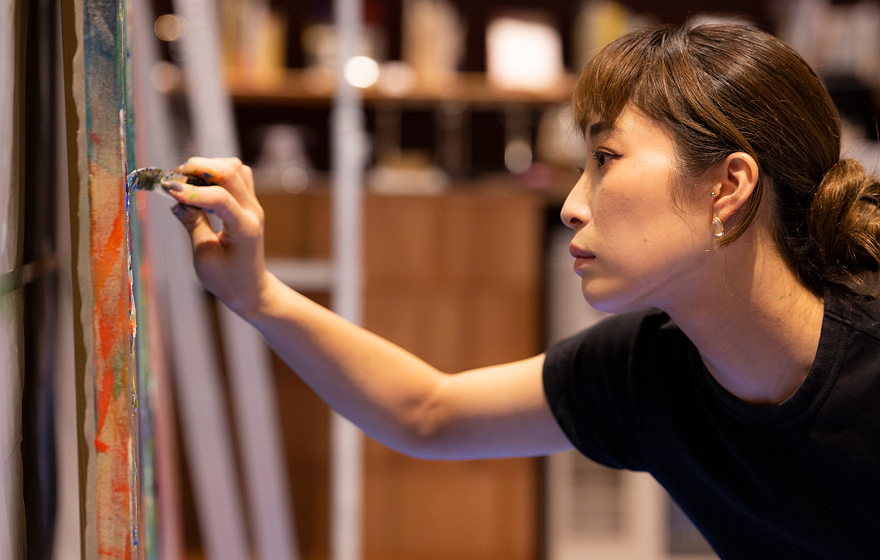
Marino Funahashi (b. 1989, Aichi, Japan) is a contemporary painter whose practice centers on the circulation of memory and the subtle traces that remain after experiences fade. Growing up under the influence of her father, a painter, she developed an early relationship with painting and later completed her MFA at Musashino Art University, specializing in spatial design.
Funahashi’s work explores what she describes as the “presence of absence”—the colors, textures, and atmospheres that persist in memory even after concrete imagery disappears. Through layered pigments and material textures, her paintings construct atmospheric landscapes shaped by perception rather than representation.
She has participated in international art fairs including those in Denmark and Abu Dhabi. In 2026, she will present her first solo exhibition in Hong Kong. Selected exhibitions include UNSEEN: Quiet Landscapes Within (KARUIZAWA NEW ART MUSEUM, Nagano, 2025) and Inner Elements (EVERANDART, Tokyo, 2025).
Statement
Filtered Perception — The Circulation of Memory and Landscapes of Coexistence
The vivid scenes and tangible materials once held by passing time gradually lose their contours and fade as they move through cycles of memory. We absorb only what appears before our eyes, repeatedly reflecting upon it until it becomes beautified and settles as sediment within memory.
Today, we live in an age where visual information is consumed at the speed of light. The excessive flow of symbolized information diminishes the sense of reality in things, taking away the time we once had to deeply confront a single object.
I reinterpret my own characteristic—of not retaining memories as clear episodes—as a form of filtration. Rather than focusing on what happened, I elevate the colors and textures that remain in my mind—what I call the “framework of sensation.” When these painted fragments are perceived again and accumulated as new memories, I consider this process to be the circulation of memory.
This process contains many elements that cannot be translated into language or fully captured on the surface of an image. Through the layering of physical brushstrokes and material textures, I attempt to preserve the analog density of time on the canvas, holding the light of a particular moment within the work.
I hope that the screen—constructed as a “symbolic abstraction” depicting a landscape where diverse elements coexist and harmonize without boundaries—will connect with the viewer’s vague inner memories and provide an opportunity to face the “inner silence” that is gradually being lost.
Marino Funahashi